


AI changed the math of cyberattacks, and this diagram is the whole story on one page: AI finds the vulnerabilities, defines the attacks, and crime-as-a-service kits carry them out — against ALL companies, including yours. Your attack surface has never been bigger.
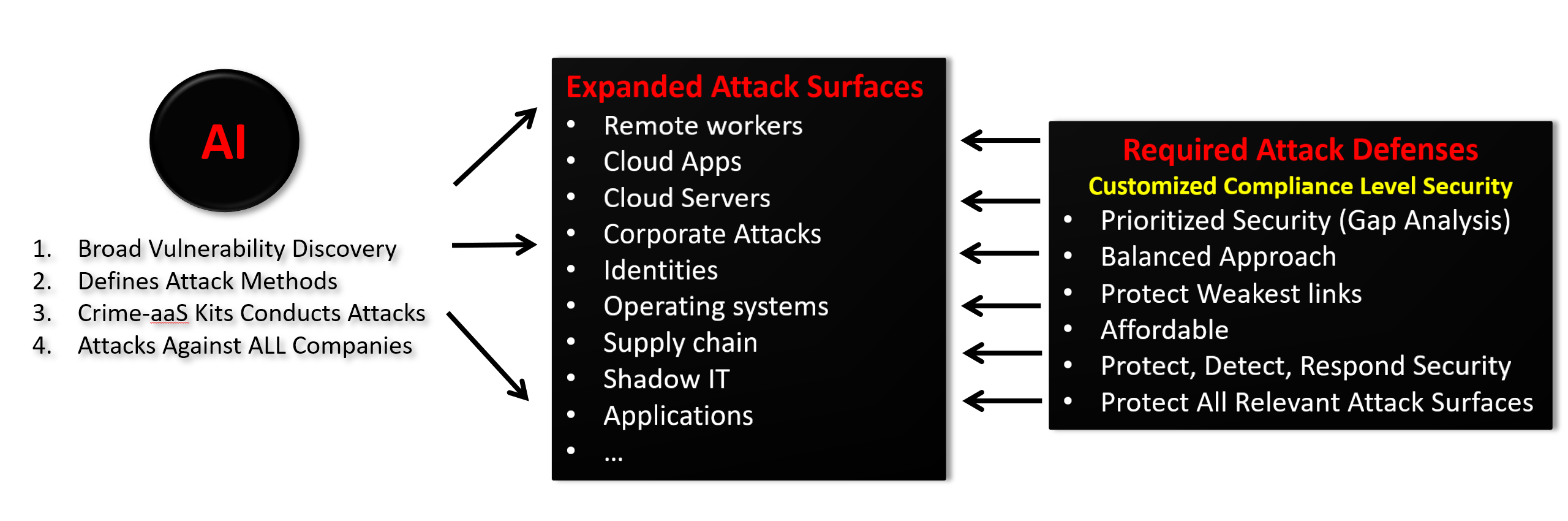
Read every attack below through this lens. On the left: what AI hands attackers — broad vulnerability discovery, defined attack methods, and crime-as-a-service kits that conduct the attacks, all aimed at ALL companies. In the middle: where those attacks land — your expanded attack surfaces, from remote workers and cloud apps to identities, supply chain, and shadow IT. On the right: the required response — Customized Compliance Level Security: prioritized through gap analysis, balanced across every surface, affordable, and built to protect, detect, and respond.
This isn’t the week AI attacks became real. That’s settled history. This is the week the arrows found companies like yours: a Pennsylvania parts retailer, a Pennsylvania bank, eleven small businesses with their names on leak boards, and an AI agent swarm that left its own playbook behind. Here’s the evidence, by category.
AI Executed or Accelerated Attacks (by third parties)
Turn5: Infostealers Emptied the Keys Before the Extortion Began
- Attack Summary: Infostealer-to-extortion — a ransomware crew harvested credentials from employee machines, then exfiltrated 328 GB.
- Victim(s): Turn5 (Pennsylvania automotive aftermarket company)
- Company size: Mid-size U.S. retailer (hundreds of employees, e-commerce)
- Attack Description: “Cavalier” infostealer malware stole credentials from six employees’ and three third-party users’ machines, plus 303 exposed passwords (34 rated critical) — compromising M365, Atlassian, Zendesk, and Anthropic sessions. No firewall was beaten; the attackers picked up the keys from browsers and session stores.
- Vulnerability Exploited: Stolen credentials and active SaaS sessions.
- Impact: 328 GB (26,503 files) exfiltrated; the Global Secret Group now holds public-leak leverage over the company.
- Source(s): QPulse/Quasar CyberTech and HudsonRock infostealer intelligence.
The Week’s Leak Board: U.S. Small Businesses, Listed Like Inventory
- Attack Summary: At least eleven U.S. small and mid-size businesses appeared on ransomware leak sites in a single week.
- Victim(s): Kooltronic (Pennington, NJ — enclosure-cooling manufacturer); Polishing Proz (Centennial, CO — 3–6 employees); All Smiles Dental (Falls Church, VA); Acme Stamping & Wire Forming (Pittsburgh — 20 employees, $5M revenue); The New Community School (Richmond, VA); Heidi’s Events & Catering; Center State Engineering; Bold Spring Nursery; Silicon Valley Glass; Unident Group; magnals.com
- Company size: All small to mid-size U.S. businesses — from a 3-person shop to regional manufacturers
- Attack Description: Five ransomware groups ran the exfiltrate-then-encrypt double-extortion playbook — a stone-polishing shop, a dyslexia school, and a catering company made the same lists as manufacturers.
- Vulnerability Exploited: Standard SMB exposure — thin detection, unpatched systems, no one watching at 2 AM.
- Impact: Each listing is active double extortion. For the dental practice and the school, notification letters are the reputation cost that outlives any ransom.
- Source(s): Cyber Threat Intelligence / ransomware.live, ThreatMon, QPulse leak-site monitoring. (Leak-site claims, not confirmed breaches.)
- The industry context: Zscaler’s ThreatLabz measured AI-assisted ransomware data theft up 275% year over year — $328M paid, 896 terabytes stolen.
Employee Created or Caused Attacks
A Bank Employee Pasted Customer SSNs Into a Chatbot — It Became an SEC Filing
- Attack Summary: An employee fed customer names, birthdates, and Social Security numbers into an unauthorized external AI tool — material enough to require a Form 8-K.
- Victim(s): Community Bank (CB Financial Services), Pennsylvania regional bank
- Company size: Small regional U.S. bank
- Attack Description: The employee pasted customer PII into the tool to work faster. Customer Social Security numbers handed to a model run by someone else, because the approved workflow was slower.
- Vulnerability Exploited: Shadow AI — no control between the employee and the paste.
- Impact: Customer PII in a third-party model; SEC filing; regulatory and notification costs plus trust damage.
- Source(s): Kayne McGladrey analysis (Netskope, Verizon DBIR 2026).
16,000 AI-Built Apps Left Their Databases Wide Open
- Attack Summary: Vibe-coded apps shipped with publicly exposed databases — the AI never made them private, and no human checked.
- Victim(s): Users of ~16,000 AI-generated applications (small teams and solo builders)
- Company size: Overwhelmingly small teams — the SMB software economy
- Attack Description: UpGuard found roughly 16,000 databases on Supabase — built by AI-generated apps — publicly accessible, exposing user names, addresses, phone numbers, and passwords. Nobody hacked anything.
- Vulnerability Exploited: AI-generated misconfiguration — databases defaulted to public.
- Impact: Tens of thousands of end users’ personal data exposed; every affected builder now owns a breach notification they never saw coming.
- Source(s): UpGuard research via TechCrunch.
New or Novel Attacks
CyberXero: 51 AI Agents Running a Fully Automated Attack Campaign
- Attack Summary: A Russian-speaking operator ran 51 specialized Claude Code agents plus an autonomous pentest agent to steal 628,000+ records — defeating the AI’s safety refusals by calling it an “authorized pentest.”
- Victim(s): Four Ukrainian organizations (628,000+ records); exposed Redis servers; compromises also reported in Poland, China, and the Netherlands
- Company size: Organizations of all sizes; a parallel automated pipeline hit WordPress/e-commerce sites globally (CVE-2026-63030, CVE-2026-60137, CVE-2026-4815)
- Attack Description: SOCRadar found the operator’s workstation with an open directory — AI session logs, plaintext tokens, tool configs. The stack: 51 specialized Claude Code agents plus PentAGI, wired into Cobalt Strike. The safety guardrails proved probabilistic, not structural.
- Vulnerability Exploited: Exposed services (WordPress, Redis) plus context-engineered AI safety bypasses.
- Impact: 628,000+ records stolen; a proven template for fully automated AI-driven campaigns.
- Source(s): SOCRadar research via The Hacker News.
The Insight: The AI That’s Attacking You Takes Notes
Two of this week’s stories proved the same point from opposite directions — and it’s good news for defenders.
The CyberXero operator was exposed because his own AI left its diary open: session logs, plaintext tokens, and tool configs sitting in a public directory. Days earlier, investigators identified the suspected Korean-bank attacker the same way — recovering his AI pentest tool’s config files and conversation logs, including the Claude session where he asked the AI to draft his “security researcher résumé” (age 26, Maoming, Guangdong) and where to sell stolen Korean data.
AI agents are efficient attackers, but they are terrible at covering their tracks — they log everything, and they don’t know what’s incriminating. That means behavioral detection and anomaly monitoring aren’t just defensive hygiene anymore; they’re how these campaigns actually get caught. The attackers have industrialized the break-in. The evidence they leave behind is industrializing the detection — but only for companies that are watching.
AI Planning Considerations for 2027
Every attack above points to the same planning conclusions:
- AI attacks will drive most companies to upgrade security in 2027. The only choice is whether you do it before an incident or after one.
- The attacks hit broad surfaces, not single vulnerabilities. Point solutions leave gaps the arrows will find.
- Compliance pressure keeps rising — regulations, cyber insurance requirements, and customer demands all point the same direction.
- Only Customized Compliance Level Security covers every surface that matters — prioritized to your risks, balanced, and affordable.
- Treat security as a science: formally assess your risks and gaps, build a prioritized roadmap, use experts to help monitor and respond, and upgrade on a plan instead of reacting to headlines.
Is Your Business Ready for AI Attacks?
This week’s evidence proved these things:
- Infostealers are the new front door — Turn5 lost 328 GB without a firewall being beaten
- The ransomware assembly line lists U.S. small businesses daily, and “too small to hack” is dead
- Your employees’ AI use is the leak your dashboards can’t see — 6% visibility, 67% on personal accounts
- AI-built software ships misconfigured by default — 16,000 databases proved it
- Attackers’ AI agents bypass safety guardrails when asked nicely — your defense can’t rely on the AI saying no
- The solutions most companies have were built for human-paced attackers — and the attackers aren’t human-paced anymore
eSecurity Solutions can help you assess your readiness for AI-driven attacks, define the right solutions for your business, and help implement and manage them for you.
Defending against attacks like these takes security built for the AI era. Learn more about our AI security solutions for AI-enabled threats.